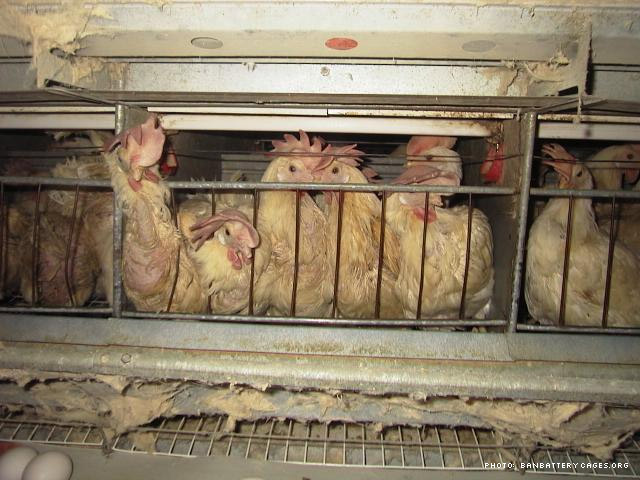
Proposition 2's opponents are agribusiness corporations masquerading as "safe-food" advocates, and they are trying to trick you. The largest donor is Moark, an egg factory farming operation from Missouri that has kicked in $800,000. This company settled criminal charges for dumping live chicks in a Dumpster, and Moark's California egg factory farm was the subject of a recent investigation finding filth and cruelty at the plant. The second largest donor at nearly $600,000 is Cal-Maine, another egg factory farming company, from Mississippi. These companies and others opposed to Proposition 2 are under investigation by the Department of Justice for illegally fixing egg prices that has consumers paying 40 percent more now than they did two years ago.
Don't be fooled. The power to end the suffering of millions of farm animals is in your hands. If you care about animal welfare, family farms, consumer protection, the environment and food safety, then please vote "yes" on Proposition 2.
Thursday, October 30, 2008
'Yes' on Proposition 2
Plan to promote precision farming techniques

Each cluster would be developed in an area measuring 20 hectares. It would help farmers learn modern agriculture practices, use modern agriculture equipment, sophisticated irrigation management and pest control measures and application of organic manure and micro-nutrients.
With shortage of labour and increase in agriculture inputs, precision farming would not only scale down production cost but also ramp up production and ultimately profits.
One user group would be created for each cluster. All implements would be done through user group only. A hi-tech green house would also be developed in an area measuring 50,000 square metres.
To meet a growing demand for organic manure, 1,300 farmers — 100 farmers in each block in 13 blocks — would be engaged in organic manure production. They had been trained in use of vermi-compost and bio-fertilisers, she said.
A modern community nursery exclusively for sugarcane, cotton, sunflower, maize, pulses and oil seeds would also established to supply quality seedlings to farmers, for which Rs.25 lakh had been sanctioned.
Organisers were selected for eight blocks to set up agriculture clinics and small soil testing laboratories. Training was imparted to four organisers.
Identification of organisers was under way to set up the centres in rest of the blocks.
Each organiser would get Rs.6 lakh with 50 per cent subsidy. And Rs.42 lakh had been sanctioned for setting up of these clinics.
Self-help groups and members of Tamil Nadu Women in Agriculture would also be involved in seed purification unit to supply quality seeds to farmers.
Fish farming needs rules

The Gulf of Mexico Fishery Management Council is meeting in Mobile this week to consider adopting rules on fish farming. It should wait, and let Congress weigh in with consistent standards to be applied to all federal waters.
Fish farming sounds intuitively benign, using floating pens to raise fish or shellfish. But beneath the surface — literally and figuratively — there are real and serious dangers.
Ocean fish farming elsewhere in the United States and around the world has produced problems few, if any, anticipated before the simple-sounding idea took off.
But experience has shown that the problems are real.
That includes pollution of surrounding seawater and ocean bottom from the accumulation of concentrated feces and uneaten fish food, and from the antibiotics and other medicines used in response to diseases and other problems caused by the concentration of large numbers of commercially grown fish in a small area.
There have also been serious problems with parasites and diseases spreading between confined commercial fish populations and wild fish that pass near the farms, or from commercial fish that escape.
That problem is magnified if the commercial fish include genetically modified species that can escape and mate with wild fish.
Congress is considering standardized fish farming rules under the National Offshore Aquaculture Act, which would provide a regulatory framework similar to regulations on wild-caught fish.
The last thing the Gulf's beleaguered commercial fishermen — or it sports fishermen — need are unanticipated problems from poorly considered fish farming off our shores.
Overhaul farming policy for drought, says Productivity Commission

The report will also say the existing EC system is dividing communities because eligibility for assistance is given according to arbitrary lines on a map indicating which areas are drought-declared.
The release of the report follows news in The Australian yesterday that the National Farmers Federation had scrapped its long-term support for the EC system.
In its submission to the Productivity Commission's inquiry into drought assistance, the NFF called for adaptation grants for successful farmers and HECS-style loans to help others build their businesses to the point where they can afford to invest in adaptation. The NFF also called for time-limited income support for struggling producers while they considered whether to apply for exit grants to leave the land.
The Productivity Commission's report is the last of three reports commissioned by the Rudd Government when it took office late last year.
A Bureau of Meteorology report released earlier this year warned of more frequent droughts because of climate change, while an expert panel investigating the social effects of drought last week called for an end to no-strings assistance.
Today's Productivity Commission report, a draft ahead of a final report in February, is expected to criticise the design of the EC system, created by the Keating Labor government in 1992.
The report is expected to say that the system does nothing to encourage farmers to change their practices and that the need for adaptation is becoming more serious because of climate change.
It will say the lack of incentives for change encourages farmers whose operations are unprofitable to continue to use bad management practices.
During last year's election campaign, Kevin Rudd promised to spend $55 million on training and re-establishment grants for primary producers, as well as $15million for research into better farming practices and $60million to retrain farmers in better farming practices.
The Productivity Commission report is expected to advise the Government to lift these financial undertakings.
Agriculture Minister Tony Burke was unavailable to comment yesterday, but has previously said any changes would not leave current EC recipients without support.
Opposition agriculture spokesman John Cobb agreed there was a need for reform of the EC system, provided there were proper transitional arrangements to ensure people were not suddenly denied income support.
DAIRY FARMING AMERICAN-STYLE IN CHINA

"We want to provide all the Chinese people [the ability to] drink fresh milk," said ER Hong, HuaXia’s Chief Strategy Officer, as we walked around the clean yet odorous farm that’s home to 5,000 cows and a lot of imported technology.
"In China right now, most people are not drinking fresh milk," continued the Taiwan native who says he grew up drinking fresh milk daily and talks about dairy as a basic human right. "Not many places can produce fresh milk."
It might sound like an odd pitch to make, given the bad press dairy products have been getting here lately. In September, the industrial chemical melamine was discovered in Chinese-made powdered and fresh milk and other dairy products sold in China and exported to parts of East Asia and Africa. Four babies died from kidney failure and at least 54,000 other young children in China have fallen ill as a result of drinking the tainted milk.
But HuaXia is poised to help overhaul the way millions of dairy farms operate across the country.
Bringing U.S. technology to Chinese agriculture
HuaXia was founded four years ago by Charles Shao, a 49-year-old information technology specialist, when he decided to pack up his life in Santa Monica, Calif., after the venture he was involved in sold to Google for a princely sum. "This was kind of a retirement for me," he laughed.
But when he arrived in China in 2003, he was determined to start his next adventure in an entirely different field. "[Some friends and I] were looking into either a vineyard or a dairy farm, and I choose the dairy farm," said Shao, whose mild manner belies an instinct for ambitious enterprise.
Adrienne Mong/NBC News
Hua Xia Dairy Farm has 5,000 cows, making it one of the largest in China.
Agriculture, as he saw it, was the last frontier in China’s economy. "If you try to set up a technology company here, there’s pretty much competition everywhere."
Moreover, there was an opportunity to make a real difference by focusing on agriculture. "The idea of dairy farming is actually to bring in U.S. technologies to do technology transfer so we can teach people in China how to do dairy farming correctly," he said.
It might sound presumptuous, but ongoing food safety scandals over the decades suggest Chinese farmers could use the help. Last month, melamine was discovered in not only powdered milk but also fresh milk, yoghurt, and some brands of cookies and candies.
And just this past weekend, authorities in Hong Kong found melamine in chicken eggs produced by a food distributor in the northeastern Chinese port city of Dalian.
Trying to regulate a fragmented system
The central government continues to take steps to try to address the problems of food safety; they include adopting a comprehensive food safety law and consolidating regulatory agencies to tighten oversight, but regulation may not be enough.
"We’ve found in other countries, when you have separate systems, one for the farm, one for industrial production, one for the retail sector and so on, it doesn’t work," said Jorgen Schlundt, Director of the World Health Organization’s Food Safety, Zoonoses, and Foodborne Diseases.
And China’s food production and supply chain is highly fragmented – especially the dairy system, which consists of millions of individual farmers who have been encouraged in recent years by government reformers seeking to promote dairy farming as an alternative income source.
"You have small-scale farmers that have four cows or eight cows," said David Oliver, an agriculture consultant. "They then sell to their larger milk companies. Quite often, they don’t have their own milking shed facilities like you would find in the U.S. So what they do every day is bring their cows to a community milking shed. The milk is then sent to the milk company. Sometimes those milking sheds are owned directly by the milk company but at other times they’re owned by a third party contractor."
It’s those third-party contractors who are suspected of being central in this latest scandal. Last week, six people were arrested for either selling melamine to milk suppliers or adding the chemical themselves directly to milk.
NBC News cameraman David Lom and assistant Ed Flanagan get up close and personal with the cows.
One of HuaXia’s operational advantages is its size. Of the 5,000 cows it owns – making it one of the top 20 largest dairy farms in the country – 1,000 are milking cows, producing 30 tons of milk a day.
All the animals are closely monitored for illnesses, and the milk produced is tested on a daily basis by the farm itself and on a weekly basis by an independent lab hired by HuaXia. The milk is then sent directly to a processing plant for packaging, eliminating the need for a middleman.
It’s a single-stream system – from the farm directly to the table – that experts like Schlundt and his colleagues at the WHO say is key to ensuring food safety.
Shao and his colleagues have invested in state-of-the-art equipment to help monitor the quality of their milk, thus making the farm work like an assembly factory.
"Even though we have U.S. technologies, we’re still in China," said Shao. There are no specialist herdsmen and farm labor is unskilled. "We instead have to compartmentalize and make our staff task-oriented," he explained. "The concept of high quality, quality assurance, and all these things is new to them."
HuaXia’s cows come from New Zealand or Australia, and the heavy equipment – like the mixing wagon to feed the animals, as well as the tractor required to pull the wagon – comes from the U.S.
Shao and his team’s efforts to run a tight ship are paying off. Not only have they easily weathered the milk scandal, their reputation for safe, fresh milk is gathering momentum. HuaXia already works with the U.S. Grains Council as a demonstration farm and training center for Chinese farmers. And the company is hoping to gain the seal of approval for quality and safety from the U.S. Food and Drug Administration.
"It’s possible to change how dairy farming is in China," said Shao. "We’re a good example!"
Monday, October 27, 2008
Monsanto Cites Strong Demand

Monsanto says agricultural demand is still healthy globally. Pictured here is a researcher at the company's Peyrehorade laboratory in France.
The world's largest producer of traits and seeds by revenue has seen its market capitalization halved over the past 10 weeks as investors worry about the outlook for demand and pricing for crops.
Monsanto Chief Executive Hugh Grant said that, despite the gyrations in commodity prices, demand fundamentals remain intact for the company's corn, soy and vegetable seeds and traits, which offer protection against pests and drought.
The St. Louis company on Wednesday increased its long-term profit forecast amid acquisitions and new-product launches.
Mr. Grant said gross profit in 2012 is expected to reach $9.5 billion to $9.75 billion, ahead of what he described as a "bold" forecast given by the company last November. Monsanto also issued a 2009 earnings forecast, which undershot analysts' estimates. "We do control the factors that truly drive our business," Mr. Grant said on a call with analysts to discuss the company's fiscal 2008 results.
While acknowledging demand growth may fluctuate, he expressed confidence that the combination of rising protein consumption in emerging markets and low commodity stocks will boost earnings. He also said Monsanto would continue to create new products that would command premium prices.
Terry Crews, Monsanto's chief financial officer, said farmers in the U.S., Brazil and Argentina still enjoyed access to credit from government sources, banks and vendors. Tougher financing conditions have contributed to sharp falls in the share prices of equipment manufacturers such as Deere & Co. But Monsanto executives say seeds are the last input that farmers would seek to curb.
Mr. Crews said price increases for its seeds and traits in the U.S. are expected to be above its targeted 16%-18% range next year, with volume growth in the low single-digits.
Monsanto reported a net loss of $172 million, or 31 cents a share, in its fiscal fourth quarter, which ended Aug. 31. This compares with a net loss of $210 million, or 39 cents a share, a year earlier, in what is traditionally the company's weakest quarter.
Revenue climbed 35% to $2.05 billion, while the gross profit margin rose to 46.8% from 42.4%.
The fourth-quarter performance was foreshadowed last week when Monsanto boosted its fiscal 2008 guidance for the seventh time this year.
Sales for the segment that includes the company's seeds and traits business increased 27% to $941 million as corn sales rose 3% and soybean sales more than doubled.
Revenue increased 43% to $1.11 billion for Monsanto's agricultural-productivity products, which include the company's Roundup lawn-and-garden herbicide as well as crop-protection, herbicide and animal-agriculture products.
The company projected earnings of $4.20 to $4.40 a share for the new fiscal year, below analysts' expectations for net income of $4.62 a share. For fiscal year 2008, Monsanto posted net income of $3.62 a share.
Thursday, October 23, 2008
Corn, soybeans looking good, but prices aren't
CHAMPAIGN, Ill. (AP) — A farming season that once appeared to be doomed by the weather has turned out pretty good for Midwest soybean and corn crops.
But, to the surprise of farmers harvesting soybeans and starting on corn, it's the fall of once record-high prices that now threatens to take a lot of the shine off of 2008.
"Our potential was there," said Rolland Vandeveer, who has more than 5,000 acres of corn and soybeans near Salem, Ill., about 80 miles east of St. Louis. "This probably was going to be our best year for the last 20 years."
Farmers in Illinois and Iowa, the country's top corn and soybean producers, endured wet, cool springs that slowed planting and growth. Then they watched heavy, soaking rains and rising rivers swamp their fields, forcing many to plant their crops two or even three times.
All the while, though, prices held close to the record highs of the past couple of years, price peaks driven by the ethanol boom and growing global demand for food and livestock feed.
But as the summer wore on, crops looked better, expectations improved, and prices sagged.
Corn topped $7 a bushel and pushed toward $8 in midsummer, but has since fallen back to about $4.
Similarly, soybeans are selling for just under $9 a bushel now, well off the $16-plus they were going for in June.

Some farmers paid well over $800 a ton for fertilizer over the summer, more than double what they paid a year earlier.
"We've had a huge increase in production cost over this time, and people's expectations have changed so much over time," Pat Westhoff, an agricultural economist at the University of
 Missouri said, explaining that farmers are accustomed to unusually high prices for their crops. "People have gotten used to that kind of world, but we're not in that world anymore."
Price problems aside, farmers and crop experts say the soybeans and corn being harvested so far look pretty good, particularly given the rough start to the season.
The harvest isn't as far along as it would normally be.
The Illinois Department of Agriculture says only about 20 percent of the state's 11.9 million-acre corn crop has been harvested so far, compared with about 63 percent at this point the past few years. Forty-five percent of the 9.2 million acres of soybeans have been harvested, compared to 70 percent or so in recent years.
Ken Cripe said he's seen a lot of soybeans but only a little corn come in so far at his grain elevator in Bluff City, Ill., about 70 miles east of St. Louis.
"The soybean quality is real good, and the yield looks good," he said as he watched a line of trucks wait to unload.
The little bit of corn he's seen looks promising, too, Cripe said.
The U.S. Department of Agriculture has gradually ratcheted up expectations for both crops since the wet spring.
Earlier this month, the USDA said it expects American farmers to harvest 12.2 billion bushels of corn, which would be the second largest corn crop on record after last year's biggest ever. The agency expects 2.98 billion bushels of soybeans, 11 percent more than a year ago.
With that in mind, Westhoff said many farmers will still have a good financial year. But in some cases, the combination of high costs and diminished prices could prove painful.

He said if someone owns all the land they operate, the chances are good that they can cover their costs and likely make a significant profit. But it might be more difficult for those who rent.
Monty Whipple, like a lot of farmers, figures it was time for the run of sky-high crop prices to end.
Whipple grows corn and soybeans near Utica, Ill., about 90 miles southwest of Chicago.
"You know that it has its up and downs and cycles, and nothing stays glamorous forever," he said.
But he admits that he, and maybe a lot of others, started thinking those prices might just last a while longer.
"We all get caught thinking things will never go back down," he said.
Minister Seeks to Turn Farming Into Export Industry
Soon after taking office in August, Food, Agriculture, Forestry and Fisheries Minister Chang Tae-pyong presented a new goal ― to achieve $10 billion in exports of farm and marine products by 2012, more than doubling last year's $4.2 billion.
"Many say it doesn't seem plausible, but I think it's possible," the minister said. "Of the exports so far this year, unprocessed farm products topped $600 million, unprocessed marine products $1.2 billion and processed food $1.9 billion. And the key lies in processed food,'' he said in an exclusive interview with The Korea Times Tuesday at his office in Gwacheon, Gyeonggi Provice, on the occasion of the 58th anniversary of the daily, which falls on Nov. 1.
"It is all about technology. It is the role of technology to make better ingredients, or even additives, for food. With better technology, it will also be possible to export processed materials made of imported ingredients. It is all about how to add value, and how to efficiently do it," Chang said.
Exporting is important because it creates more demand for farm and marine products, helping farmers and fishermen to earn more income, according to the minister.
"For example, this year saw a bumper harvest of cucumber. However, it only ended up halving its price, forcing farmers to scrap a lot of their harvest," Chang said.
Korean farmers need to export more, he said. "Cucumber is one of the most popular vegetables in the world. Expanding exports could prevent such a pitiful occasion."
For more exports, farmers need to change their point of view in an "innovative" way, the minister said, because each market has a different standard of favored products and it is important to produce what consumers want in specific markets.
"Up to now, farmers have just raised pigs. Now they need to know their main work is to supply pork for the market. In other words, agriculture is about providing consumers with ingredients they need," he said.
This offers a valuable cue to what is in Chang's mind. Farming and fishing are another form of manufacturing industry. And he didn't deny it.
"All farmers are CEOs of their own business," the official said. "Agriculture is no different from the manufacturing of products in plants, that's what I believe. Science and technology should occupy more room in agricultural management."
So, inevitably, it all comes back to one word ― productivity.
"Market competition is essential," he said. "Because competitors are everywhere, even outside Korea. At the same quality, prices should be competitive. In that regard, farmers need to make process innovation as other manufacturers do at factories.
"With the same budget, farmers can produce more by cutting expenses in each step of their work process, like plant managers do for their work."
Productivity varies in Korean farming circles, Chang said.
In a survey of rice farmers last year, the most productive 20 percent produced nearly 3.5 times more rice than the least productive 20 percent on average. The gap grew from a 2004 survey, in which the top 20 percent of farmers produced 2.4 times more than the bottom 20 percent.
The principle is also applied to distribution of their products.
"In an exemplary case, a farmer is selling the rice he produced at three different prices according to quality. I can safely say he surely has the quality of being a good CEO," he said.
Chang started to refer to farmers as entrepreneurs back in 2004, creating the term "farming CEO." It was meant to introduce the concept of "business management" to local farmers, the minister said.
"I used to tell them: Each of you is a business owner, not hired staff. That means you have to make your own decision about production and sales," Chang said.
"It's about the way they use various resources they have.
The approach is also better for more exports, he added.
Currently Korean rice is about 3 or 4 times more expensive than foreign rice, but the price can be more than halved to an exportable level, through productive farming and adoption of quality species.
Korean ``hanwoo'' can also be exported through quality innovation and productivity enhancement like Japan's beef, Chang added.
The first thing he did since taking office was to meet local farmers every weekend. There, he saw pain, but also signs of hope.
"Even though an influx of imported products and rising prices of oil and feed have hit farming households, many farmers are doing their utmost to be more competitive," he said.
Overall, it is still a serious problem that Korean farmers are unequal in production, and, strictly speaking, Korea's agricultural production is just 50 to 60 percent of that of the Netherlands. Chang, however, says it has enough potential to make a huge leap on the global stage.
"In the future, a lot of the minister's policies will be about hiking productivity like organizing households, developing advanced agricultural technologies and establishing more infrastructure in the farming village," the minister said.
Safety Matters
In no other time in our history have consumers here been so acute and sensitive about the safety of what they eat.
After the dangers of mad cow disease become the talk of the country following the resumption of U.S. beef imports, panic is now prevailing in the whole food industry due to melamine-tainted Chinese products.
Chang assured that food safety is his top priority.
"Safety is definitely the most important, and about half of the ministry's work is about monitoring food safety. The government is obliged to supply safe food to its people," he said.
The issue is also meaningful to globalize Korean food products, as exports will be impossible without securing safety, let alone being recognized as quality products, he added.
"I do understand a lot of people are still worried about U.S. beef," Chang said. "The government will closely monitor the whole process of its import and distribution. All restaurants must clearly identify the origin of ingredients they serve."
In July, the ministry set up comprehensive measures for food safety, which include establishing a preventive system and intensified import food control. Also, it plans to make it obligatory for food dealers to keep records of their transactions this year, before completing a food distribution tracking system by 2010.
An overhaul of the related system will be soon made, the minister said. Most importantly, a project is under way to integrate all safety controls for dairy, farming and marine products, all of which are separate at present.
There will be more roles for consumers under the new system. The government will encourage more civic engagement in supervision of food-related facilities and the labeling of the origin of food.
"Safety control is basically a matter of system, so it will take some time to make it full force. But all other measures available will be introduced as soon as possible, hopefully this year," Chang said.

Investing in Antiquity

After years of uncertainty over the future of the local landmark, the town plans to spend up to $2 million to restore the exterior of the farmhouse, also known as the Marion Tavern.
"This is definitely a large step forward for is," said Nick Rubino, cochairman of the Grandview Farm Use Committee.
Residents at Town Meeting recently approved borrowing $1 million over 20 years to help pay for the renovations. The borrowing will cost about $75,000 annually, which will be covered by payments from a local developer, the Gutierrez Co., to the town. The payments were part of the three-way land swap agreement seven years ago between the former owners of the farm, the town, and the Gutierrez Co. that allowed the town to take ownership of the property.
The town also has about $800,000 from various sources available to help pay for the restoration. Additionally, the town plans to sell a single-family residential lot on the property that could generate between $250,000 and $300,000 toward the Grandview renovations, said Town Administrator Robert Mercier.
The $2 million is expected to pay for structural repairs and exterior work to the main house, the oldest part of the complex. It does not include work to the ell or the barn, which are connected to the house.
Mercier said the town will issue a request for proposals this fall for the work, and hopes to award a bid for construction by late winter and have the contractor begin work in the early spring.
"Lots of ifs in the plan, especially with the current market conditions, but this is our best hope to date to stabilize and save this structure," Mercier said via e-mail.
Better known today for its shopping and business parks along Route 128, Burlington started out as a farming community, according to Michael Tredeau, cochairman of the Burlington Historical Commission. Just 100 years ago, the town's population was 592, Tredeau said. Today, the residential population is 24,000 and its daytime population is 150,000.
The Grandview Farm complex began as a Greek Revival-style house built by the Marion family in 1830, said Tredeau. Abner Marion decided that, in addition to running a farm, he would open a tavern to attract those traveling between Boston and Lowell. He moved a pre-1750 saltbox house to the site and connected the two homes into one main house. An ell was constructed to connect the main house to the barn.
By 1870, Charles McIntire owned the property and ran a large dairy farm there. It was later turned into an egg and poultry farm. The McIntires named it Grandview Farm because its high peak had majestic views of Mount Wachusett in Princeton and Mount Monadnock in southern New Hampshire.In 1970, the property was purchased by Hubert Ruping, whose family owned the property until the three-way land swap in 2001.
Tredeau said the connected farm complex is an architectural style unique to New England. "It's the only one left in Burlington and one of only a few in the Eastern Massachusetts area" - reason enough to preserve it for posterity, he said.
"The growth has been incredibly explosive and all the farms are gone," he said. "This is a building right in the middle of town to remind us of our farming heritage. To say this property is the truest example of Burlington's heritage would not be an understatement."
Tredeau said the building is in "fair condition." The framework is solid, but the roof and foundation need work, and its exterior needs to be redone. He said it's been vacant since the town took ownership about seven years ago.
"It's not falling down, but a couple more years with nothing being done and it could get into that condition," he said.
When the town first took over the property, a committee was formed to look at how it could be used. But it became clear that the house needed work and renovations would be needed before the town could decide its best use, said Rubino. "Our focus shifted from use to saving the building," he said.
The committee raised $800,000, but it wasn't enough to do all the work, Rubino said. At one point, the committee recommended razing the structure because the renovation costs were so high.
The first phase won't fix everything, town officials acknowledge. But Rubino said it's a good start.
"From the common, certainly it should look much better," he said. "The outside will look like it should."
Rubino said the second phase will focus on the ell and the barn, and the third will target the interior.
"We do want to save that as well, but money is tight and we had to focus on the most historic portion," he said.
Once the renovations are done, the committee will once again be able to look at use. Rubino said ideas include using it as a function hall, meeting space, and offices. One idea would turn the barn into a community theater.
Tredeau said town residents should remember that while it would be nice to reuse the building, its most important purpose is to serve as a reminder of what the town used to be - a farming community.
"We have in our hands, a prime example of that agricultural industry," he wrote recently in a letter to the Board of Selectmen. "A building which was the center of commerce for this town. A building which can show us, remind us, and teach us the history and heritage of Burlington. And we need to remember the value of this building is its unique structure, and its antiquity.
Tuesday, October 21, 2008
Trouble down on the farm
The worsening financial crisis is making it harder and more expensive for farmers and cattlemen to borrow money to pay for feed, land and salaries. While the credit squeeze on the agricultural sector is buffered somewhat by subsidies and other federal assistance, the timing is nonetheless bad: the costs of fertilizer, fuel, seed and equipment have all risen sharply in recent years, and a global recession is on the horizon.
“Other than the sky is falling, I’m OK, I guess,” said West Texas rancher John Welch, who manages 10,000 head of cattle.
With confidence dwindling in borrowers’ ability to repay loans, banks are requiring more collateral and higher interest rates from crop farmers, ranchers and meat processors, said Carl Anderson, an agricultural economist at Texas A&M University. “The bankers are turning conservative.”

In response to the lending crunch, farmers and ranchers are expected to rein in costs wherever they can — whether it means using less fertilizer, restructuring debt or putting off new equipment purchases.
While the weakening global economy is putting downward pressure on fuel prices, it is also depressing the value of grains and livestock — and that will eat into farmers’ and ranchers’ pocketbooks. The upside for consumers is that food prices are likely to come down.
The agricultural sector won’t be frozen out of credit markets entirely. For starters, the industry’s traditional lenders — independent commercial banks — are on more solid financial footing than the country’s largest investment banks and commercial banks, which have suffered the most in recent months from mortgage-related losses.
Moreover, federal assistance programs put in place in response to the country’s farm crisis of 1919 are still active, helping the industry weather the current crisis.
Provisions in the Farm Bill, portions of which grew out of the Agricultural Adjustment Act of 1933, give the industry special access to government-backed loans that are nearly fully guaranteed by the U.S. Department of Agriculture’s Farm Service Agency.Historic intervention
Asset prices plunge and a panic sweeps through international markets. Congress enacts sweeping government intervention, putting aside faith in free markets to heal themselves.
Sound familiar? So went the farm crisis of 1919.
When the U.S. bailed out the agriculture sector in the early 1930s, it forever changed the business of farming. The interventions of the 1930s succeeded in their goal of smoothing out the farm sector’s booms and busts, said Neil Harl, an agricultural economics professor at Iowa State University. But farmers chafed under Depression-era programs that limited their planting acreage. Their resistance led to the 1996 Farm Bill, known as the Freedom to Farm Act, which aimed to return the farm sector to the free market.

